
A lead asks for a quote at 9:14 a.m. You are on a job site, with a client, or packing orders. By the time you reply that evening, they have contacted three competitors. That is the real problem an AI assisted sales funnel guide should solve: not replacing your sales process, but helping you respond, follow up, and sell while you run the business.
For a local service company, freelancer, agency, or ecommerce brand, a sales funnel does not need to be complicated. It needs to move the right person from interest to action with fewer delays and fewer blank-page tasks. AI gives you a faster way to create the messages, offers, content, and follow-up assets that keep that movement going.
What an AI-Assisted Sales Funnel Actually Does
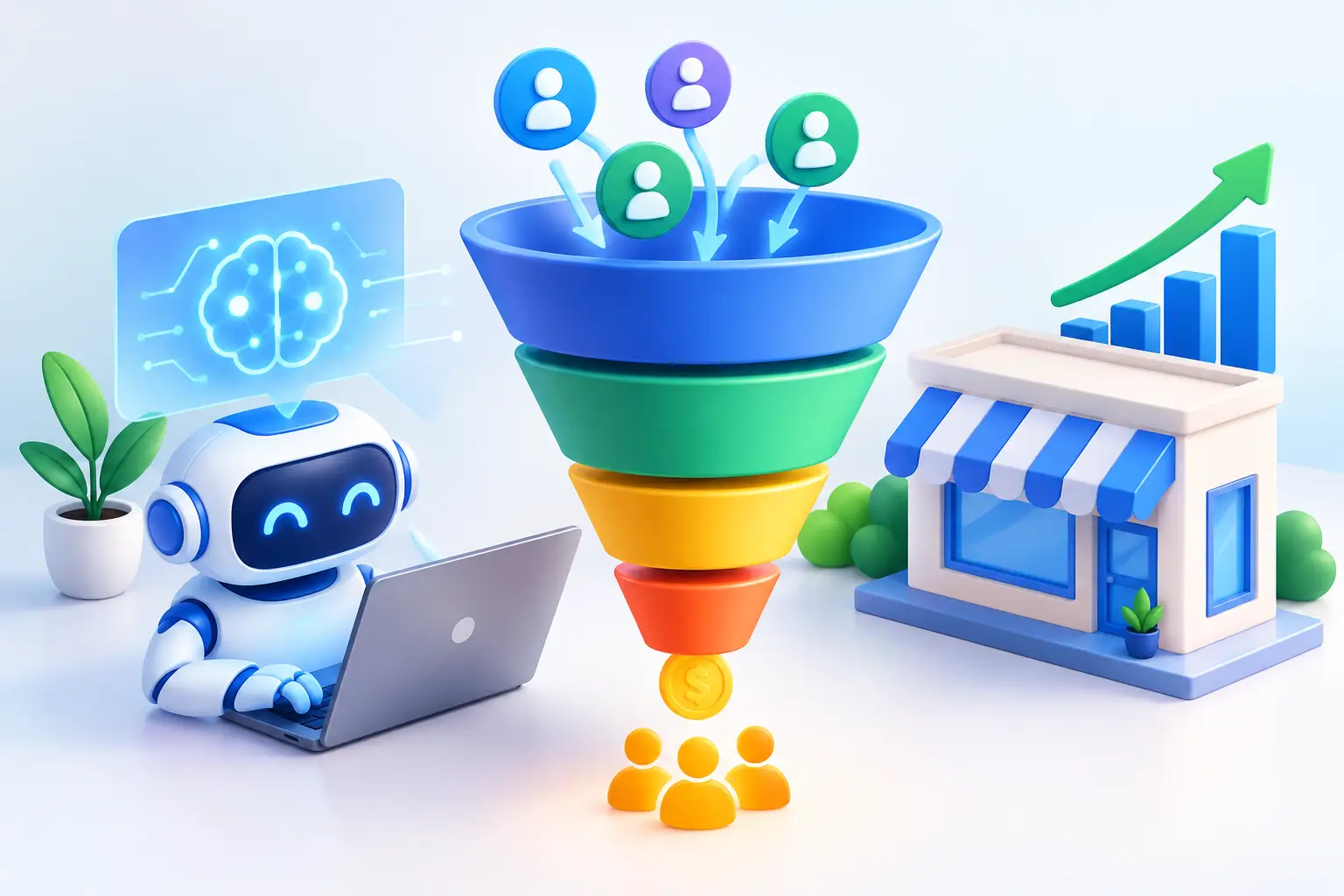
A sales funnel is the path from first attention to a paid customer. AI can support every stage, but it cannot fix a weak offer, bad reviews, slow fulfillment, or a team that never contacts leads. Think of it as a practical sales assistant. It helps you produce better materials faster, organize ideas, personalize outreach at scale, and stay consistent when work gets busy.
The best use of AI is not sending generic messages to thousands of people. It is building a repeatable system around the questions your best prospects already ask. A fence contractor might use AI to turn one project photo into neighborhood-focused social posts, estimate follow-ups, and a financing FAQ. A real estate agent might create buyer guides, listing emails, and open-house follow-up messages from the same local market insights.
The goal is simple: make it easier for a qualified prospect to understand the value, trust your business, and take the next step.
AI Assisted Sales Funnel Guide: Build the Four Stages
1. Attract attention with a specific problem
The top of the funnel is where most small businesses waste time. They post broad tips, run vague ads, or publish content that sounds like everyone else. AI can generate volume, but volume without a sharp angle rarely produces leads.
Start with one customer type and one urgent problem. Instead of asking AI for “social media posts for a plumber,” give it the job, location, season, service, and buyer concern. Ask for content aimed at homeowners dealing with a leaking water heater before a holiday weekend. That produces more useful angles, stronger calls to action, and content that sounds connected to real life.
Use AI to create variations for ads, short-form videos, local social posts, blog outlines, email opt-ins, and Google Business Profile updates. Keep the same core offer across those assets. If your offer is a free roof inspection, a quote request, a buyer checklist, or a product quiz, every piece should point toward it.
AI-generated content still needs your proof. Add real project details, before-and-after photos, customer language, service areas, pricing context where appropriate, and your own point of view. AI supplies the first draft. Your business experience makes it believable.
2. Capture the lead with a low-friction offer
Once someone is interested, do not send them to a crowded homepage and hope they figure it out. Give them one clear action. For service businesses, that may be a request form, callback request, inspection booking, or text-to-quote option. For ecommerce, it could be a first-order offer, product finder, bundle recommendation, or restock alert.
AI can help write landing page sections that answer the hesitation behind the click: What happens next? How long does it take? Is there an obligation? Do you serve my area? What does this cost? It can also turn customer reviews and sales-call notes into FAQs that reduce uncertainty before a prospect reaches out.
Do not ask for more information than you need. Name, contact method, service or product interest, and location may be enough to begin. Every extra field can lower completion rates. If your sales process requires more detail, collect it after the initial response, not before.
3. Follow up while intent is still high
Speed matters because buyer attention fades quickly. AI is especially valuable here because it removes the writing bottleneck. Create a short follow-up sequence before leads start coming in, then adjust it based on real responses.
Your first reply should acknowledge the request, state the next step, and give a realistic timeframe. A useful second message can answer a common question or show a relevant result. A third can offer a simple reason to act now, such as limited appointment availability, a seasonal deadline, or a helpful resource.
Personalization matters, but it should be honest. AI can create templates based on service type, neighborhood, product category, budget range, or stated need. Review the final message before sending, especially for high-value jobs or sensitive services. A message that gets the prospect’s name wrong or promises something you cannot deliver costs more than it saves.
For leads that go quiet, use AI to create reactivation campaigns around a new offer, seasonal service, maintenance reminder, or fresh case study. The right message is not “just checking in.” It gives the lead a useful reason to restart the conversation.
4. Convert with proof and a clear decision
At the bottom of the funnel, prospects want confidence. They may be comparing estimates, checking reviews, or waiting for the right moment. AI can help you package your proof into sales emails, proposal language, comparison sheets, objection-handling scripts, and post-consultation recaps.
For example, after a discovery call, feed your notes into a purpose-built workflow and create a concise proposal draft that reflects the customer’s goals, timeline, and concerns. Then check every detail yourself. AI can organize the message, but prices, scope, warranties, availability, and claims must come from your business.
A strong conversion message does not pressure everyone. It makes the decision easier. Restate the problem, show the recommended solution, explain what is included, and name the next action. If a prospect is not ready, offer a smaller commitment such as a consultation, sample, checklist, or follow-up date.
Give AI Better Inputs for Better Sales Output
The quality of your AI output depends on what you provide. Generic prompts create generic marketing. Build a simple reference file with your services, ideal customers, common objections, differentiators, locations served, brand voice, offer details, and approved claims.
Also collect the language customers use in calls, emails, reviews, and form submissions. Those exact phrases are valuable. If customers repeatedly say they are worried about hidden costs, missed appointments, confusing options, or cheap materials, your funnel should address those concerns directly.
This is why ready-to-use, role-specific tools can save so much time. Rather than starting with an empty chat and guessing what to ask, a focused workflow can guide a chiropractor toward patient education content or a garage door company toward urgent repair follow-up. Rocket AI Prompts is built around that kind of practical, outcome-focused starting point.
Measure the Gaps, Not Just the Leads
More leads are only useful if your funnel converts them. Track where prospects stop moving. Are people clicking ads but not filling out the form? Is the form working but follow-up taking too long? Are estimates being sent but rarely accepted? Each gap points to a different fix.
Watch a few basic numbers each month: traffic or reach, lead conversion rate, response time, appointments booked, close rate, average order value, and cost to acquire a customer. You do not need a giant dashboard to improve. You need enough visibility to spot the weakest stage.
Test one change at a time. Try a clearer offer, a shorter form, a stronger testimonial, a faster first response, or a new follow-up sequence. AI makes testing easier because it can quickly produce controlled variations. It does not make every variation good. Keep the version that improves the business result, not the one that merely sounds clever.
Keep the Human Part Where It Counts
Use AI for drafts, variations, organization, and repeatable communication. Keep human judgment for pricing, promises, customer conflict, sensitive information, and final approval. This balance protects your reputation while giving you more time to do the work that actually requires you.
A good funnel should feel helpful, not automated for the sake of automation. When every message answers a real question and every next step is easy, AI stops being a novelty. It becomes the extra set of hands that helps your business respond faster, look sharper, and earn more of the opportunities already coming your way.








0 Comments